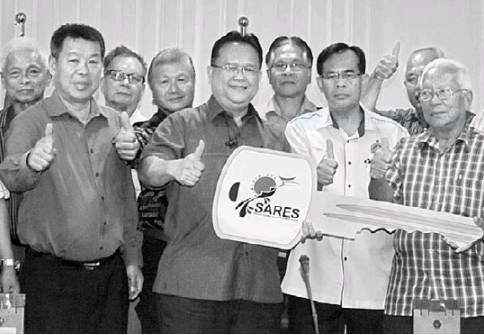
Five longhouse communities along Sungai Pelagus in Kapit, Sarawak have received their Sarawak Alternative Rural Electrification Scheme solar systems — an RM8 million project bringing 24-hour electricity to 746 residents across 135 households, many of whom had never had reliable power before.
The handover ceremony in Kapit was officiated by Datuk Alexander Nanta Linggi, Deputy Minister of Rural and Regional Development, who presented the solar systems to the headmen of five Sungai Pelagus longhouses. The communities receiving the systems were:
- Rumah Majo, Ulu Iran
- Rumah Jak, Nanga Stabau
- Rumah Sekudan, Rantau Lelenga
- Rumah George, Nanga Sebunut
- Rumah Anatu, Karangan Ara
Together, the five communities represent 135 households and 746 residents — more than double the scale of earlier SARES handovers in the Kapit division. The combined project value of RM8 million reflects both the larger scope and the increasing confidence of the state and federal governments in the SARES delivery model.
"This is crucial to me. It is very important that the capability of the solar system will become a game changer to those people in terms of daily life and also how to help them to better their standard of living."
— Datuk Alexander Nanta Linggi, Deputy Minister of Rural and Regional DevelopmentWhat 24-Hour Power Actually Means
The SARES system delivers something deceptively simple but profoundly significant — round-the-clock electricity. For longhouse communities that previously relied on small diesel generators running for a few hours a day, or had no electricity at all, the difference is not merely a matter of convenience. It restructures daily life entirely.
With continuous power, households can run fans and refrigerators — appliances Datuk Nanta specifically highlighted in his remarks. Refrigeration alone transforms food security, enabling storage of perishables and reducing the cost and frequency of river transport for food resupply. Children can study at night. Small businesses can operate equipment. Communication through mobile devices becomes reliable, connecting remote communities to markets, healthcare information, and government services.
The NBOS Partnership Model
The RM8 million project is financed through the National Blue Ocean Strategy (NBOS), a federal-state co-financing framework that splits costs equally between the Sarawak State Government and the Ministry of Rural and Regional Development. This model has proven effective in reaching communities where conventional grid extension — which requires transmission infrastructure across difficult jungle terrain — is prohibitively expensive and logistically impractical.
SARES is specifically designed for remote clusters of villages and longhouses that cannot be connected to the power grid in the near term. By bringing solar to these communities now, rather than waiting for grid expansion that may be decades away, the programme delivers measurable development impact within a defined project timeline and budget.
A Growing Pattern of Delivery
The Sungai Pelagus handover follows a series of SARES completions across the Kapit division, establishing a pattern of reliable delivery that has built trust between the implementing agencies, state and federal governments, and the communities themselves. Each successful handover strengthens the case for continued investment in the programme and demonstrates the viability of solar as a permanent electrification solution for East Malaysia's interior.
Present at the ceremony were Bukit Goram assemblyman Jefferson Jamit Unyat and Kapit Resident Joseph Belayong Punan — a signal of the political and administrative significance attached to the handover at both the state and district level.